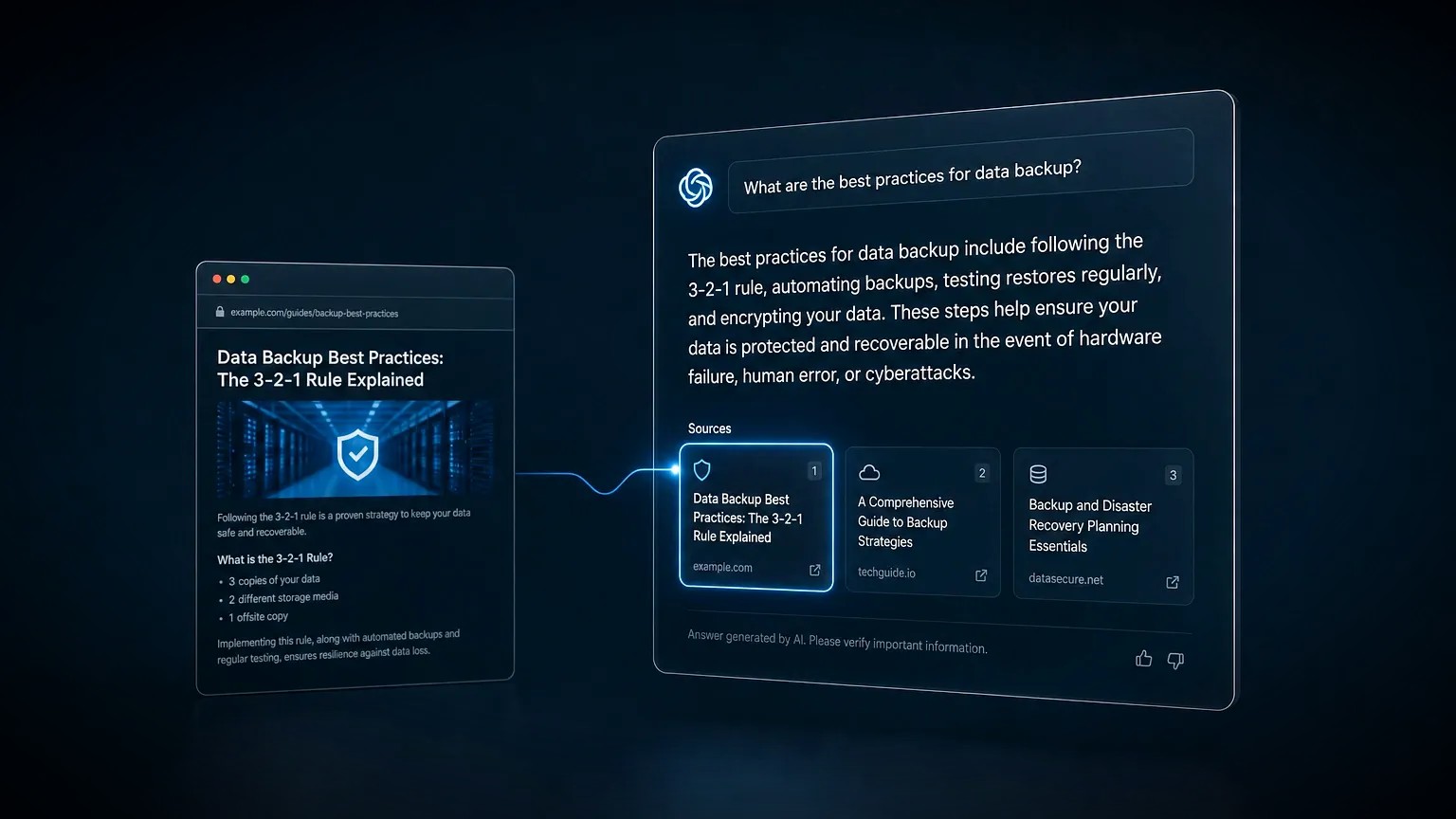
Answer engine optimization (AEO) is the practice of structuring content so that AI answer engines quote it directly in their responses, rather than simply ranking it in a list of links. As tools such as ChatGPT, Perplexity, Google AI Overviews and Gemini answer questions on the page, being cited inside that answer is becoming the new front page of search.
Answer engine optimization (AEO) is the practice of creating and structuring content so AI answer engines cite it when they generate responses. Where traditional SEO aims to rank a page in search results, AEO aims to have the page quoted directly in the AI-generated answer, through clear structure, explicit facts and machine-readable data.
What answer engines reward, at a glance:
- Direct answers: a clear, self-contained response to a real question, early on the page.
- Clean structure: descriptive headings and one idea per section, so a passage can be lifted without losing meaning.
- Explicit entities and facts: named things and checkable claims, not vague phrasing.
- Machine-readable data: schema markup and consistent facts that reinforce what the page says.
- Credibility: clear authorship, expertise and citations, the signals an answer engine trusts.
What is answer engine optimization (AEO)?
Answer engine optimization is search optimization aimed at AI systems that answer questions directly, rather than at the ranked list of links. An answer engine, whether it is Google's AI Overviews, ChatGPT with browsing, Perplexity or a similar tool, retrieves passages from across the web, synthesises them into a single response, and often cites the sources it used. AEO is the work of making a page one of those cited sources.
The shift matters because the answer increasingly comes before the click. When a user gets a complete response at the top of the page, the traditional blue links below it receive fewer visits, and the visibility that used to come from ranking first now comes from being quoted in the answer. AEO does not replace SEO; the two share the same foundation of crawlable, trustworthy content. It extends SEO with a sharper focus on structure, clarity and machine-readable meaning, so a page is easy for a model to retrieve, understand and quote accurately. This overlaps with what is sometimes called generative engine optimization, or GEO, but the aim is the same: to be the source an AI answer draws from, and to be attributed when it does.
How is AEO different from SEO?
AEO and SEO share a foundation but optimise for different outcomes: SEO aims to rank a page, and AEO aims to get it quoted. The table below sets the two side by side.
| Aspect | SEO | AEO |
|---|---|---|
| Goal | Rank in the list of links | Be quoted in the AI-generated answer |
| Optimises for | Crawlers, keywords and rankings | Answer engines, entities and retrieval |
| Winning content | Comprehensive pages that rank well | Clear, self-contained, quotable answers |
| Measured by | Rankings, clicks and organic traffic | Citations, brand mentions and AI referrals |
The important point is that AEO builds on SEO rather than competing with it. A page still has to be crawlable, fast and trustworthy to be considered at all. AEO then adds a layer: it structures that page so a model can find the exact passage that answers a question, understand it without ambiguity, and reproduce it accurately with attribution. In practice, content optimised for answer engines tends to perform well in traditional search too, because clarity and structure help both.
How do you optimise content for answer engines?
To optimise for answer engines, lead with a direct answer, structure the page into self-contained sections, name entities explicitly, and back the content with schema and clear authorship. The goal is a page a model can quote confidently, which means removing ambiguity at every level. These are not tricks: they are the same qualities that make content genuinely useful to a reader, which is precisely why answer engines reward them.
- Answer the question first. Put a clear, 40 to 60 word answer directly below the heading, before any build-up, so a model can lift it cleanly.
- Use descriptive, question-style headings. Headings that mirror how people actually ask questions help an answer engine match a passage to a query.
- Keep one idea per section. Self-contained sections can be quoted without losing meaning, which is exactly what retrieval needs.
- Name entities and state facts explicitly. Replace vague pronouns with the actual names, and make claims specific and checkable, a number, a date, a version, rather than general.
- Add structured data. Use schema such as FAQPage, Article and Organization so the meaning of the page is machine-readable, and keep those facts consistent with the visible text.
- Establish credibility. Show clear authorship and expertise, and cite reputable sources, because answer engines favour content they can trust and attribute.
What kind of content gets cited by AI search?
The content that gets cited by AI search is clear, specific, well-structured and trustworthy, the opposite of padded, vague or keyword-stuffed pages. Answer engines are trying to reproduce a reliable answer, so they favour passages that state something definite and can stand on their own.
In practice, that means a few recognisable qualities. Direct definitions and concise answers are easy to quote. Comparisons, steps and short lists give a model clean, liftable structure. Original data, specific numbers and named examples give a passage the specificity a model prefers over generalities. And clear signals of who wrote the content and why they are qualified, along with citations to credible sources, give an answer engine the confidence to attribute an answer to the page. Thin content that merely rephrases what everyone else says gives a model no reason to choose it.
Which answer engines should you optimise for?
The main answer engines to optimise for are Google's AI Overviews, ChatGPT, Perplexity, Gemini and Microsoft Copilot, and the useful news is that they reward broadly the same qualities. Each retrieves and synthesises content, and each favours clear, structured, trustworthy pages, so a single well-optimised page tends to perform across all of them rather than needing separate treatment.
There are differences of emphasis worth knowing. Google's AI Overviews sit on top of traditional search, so strong SEO fundamentals and structured data carry weight. Perplexity leans heavily on citations and surfaces its sources prominently, rewarding pages that state clear, quotable facts. ChatGPT and Gemini draw on both training data and live retrieval, so consistent, widely referenced information about a brand or topic helps. Rather than chase each engine separately, the practical approach is to make content clear, specific and well-structured, then track where a brand is being cited and where it is missing, using tools built to monitor AI search results, and close those gaps.
What are the common AEO mistakes?
The common AEO mistakes come from writing for keywords or word count rather than for a clear, quotable answer. A page can be long, keyword-rich and still give an answer engine nothing clean to lift.
- Burying the answer: long introductions before the page says anything definite, so a model cannot find the response.
- Vague, pronoun-heavy writing: "it" and "this" instead of the named entity, which weakens retrieval.
- No structure: walls of text under generic headings, with no self-contained passages to quote.
- Missing or inconsistent schema: structured data that is absent, or that contradicts the visible text.
- Weak credibility: no clear author, expertise or sources, so an answer engine has little reason to trust the page.
- Chasing volume over clarity: padding a page to hit a length target, which dilutes the very passages a model would quote.
Your answer engine optimization checklist
Before publishing, check a page against these points. If it passes, it is easy for both people and answer engines to understand and quote.
- The main question is answered directly and concisely, high on the page.
- Headings are descriptive and mirror real questions.
- Each section covers one idea and can stand on its own.
- Entities are named explicitly and claims are specific and checkable.
- Schema markup is present and matches the visible content.
- Authorship, expertise and sources are clear.
- The page is fast, crawlable and technically sound, the SEO foundation AEO builds on.
Answer engine optimization is not a replacement for SEO but its next layer: the same trustworthy, well-built content, structured so an AI can quote it. As more journeys end in an answer rather than a click, being the source that answer cites is the visibility worth earning. Brands that adapt early, structuring their expertise so machines can quote it, build a presence in AI answers before competitors notice the front page has moved. The work is not exotic: it is clear, credible, well-structured content, which is where good SEO was always heading. That is the thinking behind the technical SEO and AEO work on every build.
Frequently asked questions
What is answer engine optimization (AEO)?
Answer engine optimization (AEO) is the practice of structuring content so AI answer engines, such as ChatGPT, Perplexity and Google AI Overviews, cite it directly in their responses. Where SEO aims to rank a page in search results, AEO aims to have the page quoted in the AI-generated answer through clear structure, explicit facts and schema.
What is the difference between AEO and SEO?
SEO optimises a page to rank in the list of search results; AEO optimises it to be quoted in an AI-generated answer. They share the same foundation of crawlable, trustworthy content, but AEO adds a focus on direct answers, self-contained sections, named entities and machine-readable data so a model can retrieve and reproduce the content accurately.
How do you get cited by AI search engines?
To get cited by AI search engines, lead each section with a direct, self-contained answer, use descriptive question-style headings, name entities and state specific, checkable facts, add structured data such as FAQPage and Article, and show clear authorship and credible sources. Answer engines quote content that is clear, specific and trustworthy. For help putting this in place, get in touch.
Does AEO replace SEO?
No. AEO does not replace SEO; it extends it. A page still needs to be crawlable, fast and trustworthy to be considered at all, which is SEO. AEO then structures that page so an answer engine can find, understand and quote the right passage. Content optimised for answer engines usually performs well in traditional search too.
How do you measure AEO success?
AEO success is measured by citations and visibility inside AI answers rather than by rankings alone: how often a brand or page is quoted or mentioned by answer engines, referral traffic from tools like Perplexity and ChatGPT, and share of voice across AI answers for the topics that matter, tracked with tools that monitor AI search results.